Monday, September 26, 2016

Marathon Strategery

Another great day to donate! Two marathons and two charities! Let's raise a combined $6,500 for cancer research through Fred's Team and low-income seniors with Housing Opportunities and Maintenance for the Elderly (H.O.M.E.)!

Donate to H.O.M.E. here (write in "marathon" in note section). Donate to Fred's Team here. 

Donation Matching!  Donate before 11:59pm on Sunday (10/2) and all of our donations will be matched up to $750! Double your gift this week only! Let's get this chart moving!


Today I discussed marathon strategery with J. In the end we decided the most important part was not to be beaten by the fat hobbit. This is not code. But, in case you don't subscribe to the portland marathon electronic news letter, let me bring you up to speed. The actor who played the fat hobbit in the Lord of the Rings movies is running the marathon this year. That's right, Sean Astin will be puffing along with the rest of us.


In my first marathon the talented Caroline Wozniacki ran with us. I was a bit more excited about the prospect of seeing her than I am about seeing Sean. Sadly I didn't see her. Though I did see Tiki Barber. I'm sure there were plenty of other celebrities in NYC. But I don't recognize people that well, much less people I've only seen on TV.


One of the more useful strategies we discussed was managing water stops. I was given sage advice before my first marathon about drinking frequency. I was told to drink a bit of water at all stops. I thought this was excessive, in New York the first stop is at the 2nd mile. But taking water that early is actually brilliant. The plan is to delay the inevitable dehydration. If you wait until you are thirsty then you are going to be far behind the entire time.

Water stops can be dangerous. People are notoriously bad at noticing others. People, it seems, can't imaging that someone might be running right behind them. People will full stop immediately, or turn into you without any warning. And the ground is wet and full of cups, which doesn't help. The best way to deal is to head for the end of the station. Most runners attempt to grab the first cup they see and like terrified cattle stampede towards the outstretched hands of first volunteers. But if you patiently wait in the middle of the road you can ease past the dehydrated herds to the lonely water volunteers at the last table.

Also sugar is good. And as a strategy it is one of my favorites. Eating is key. Your body (or at least mine) using vast amounts of sugars to push itself up the road. If you run out of easily burnable simple sugars you will quickly turn to lead. Trust me, I know. My legs felt like solid blocks after I accidentally skipped breakfast and dinner before my first marathon.

I carry a variety of little packets of syrupy sugars. These are sold to runners as energy packets. And for once I completely agree with the marketing. There is a reason doctors tell us not to eat white breads, sugar candies, and other refined products. These things "turn into sugar" and go directly to the blood stream. And of course that is exactly what you want and need during a marathon. You can't spend time digesting and breaking down complex carbohydrates into the sugars you need. In Portland they will be passing out gummy bears at multiple locations along the route. I can't wait!

The sugar-free marathon.
I appear more alive than I actually was. I was having trouble focusing my eyes.

Sunday, September 25, 2016

Matching Donations! This Week Only

Another great day to donate! Two marathons and two charities! Let's raise a combined $6,500 for cancer research through Fred's Team and low-income seniors with Housing Opportunities and Maintenance for the Elderly (H.O.M.E.)!

Donate to H.O.M.E. here (write in "marathon" in note section). Donate to Fred's Team here. 


I may be tapering for the marathon, but the fundraising is roaring this week.

Exciting News: through the great generosity of a couple of anonymous backers we have the chance to raise serious monies this week for H.O.M.E. and Fred's Team!

In total, our backers are willing to match all donations this week - up to $750!

How does this work? It's simple. Starting now, Monday morning, choose either Fred's Team or H.O.M.E. and donate before 11:59pm on Sunday (10/2). Your donation, and all donations up to $750, will be matched dollar for dollar by our backers with donations of their own at the conclusion of drive!

This is how excited I am about matched donations!

It would be a real shame to let any of this money slip away and keep lining their pockets. Let's make use of it all! Tell your friends. Tell your parents. Tell your upstairs neighbor who vacuums at 7am on Saturday morning. And donate today!

Remember, your donation to H.O.M.E. will go to provide low-income seniors with safe and affordable housing and many more crucial services. And your donation to Fred's Team will provide much needed funds for cancer research!

Read more about the great work done by H.O.M.E. to serve a vulnerable population on their website. Read about when I went and visited one of their apartment buildings too! Check out Fred's Team website to find out who Fred was. And ask me about cancer research and cancer treatment at Sloan Kettering!


Thursday, September 22, 2016

Fundraising

Another great day to donate! Two marathons and two charities! Let's raise a combined $6,500 for cancer research through Fred's Team and low-income seniors with Housing Opportunities and Maintenance for the Elderly (H.O.M.E.)!

Donate to H.O.M.E. here. Donate to Fred's Team here. More information here and at the top of the blog!

I wanted to bring you up-to-date, my loyal fans, on our fundraising progress. The marathons are fast approaching and we need to see just where we stand. There are only 15 days till Portland!

First, thank you all for the donations! At the moment we are 14% of the way towards raising 6500 dollars! It is a great start, but I think we can do better. Check out these awesome charts that visualize our progress.

That green bar (14%) will jump up with each donation!
Let's get these real numbers up! I know you can do it.

And for those of you who are playing along and using the Marathon Donation Calculator check out my running progress. I had a very good 20 mile run last weekend. My overall pace was 8:48 - and my last mile (the only measured mile) was 8:15. This puts me solidly under an expected 3:52 marathon time.

Third from last dot is the 20 miler. The one before that is a 10 miler. Boom.

Wednesday, September 21, 2016

Coming of Age

Another great day to donate! Two marathons and two charities! Let's raise a combined $6,500 for cancer research through Fred's Team and low-income seniors with Housing Opportunities and Maintenance for the Elderly (H.O.M.E.)!

Donate to H.O.M.E. here. Donate to Fred's Team here. More information here and at the top of the blog!

A runner must run with dreams in his heart. - Emil Zatopek

I.

Subway polls are always sticky. I wash my hands often, not often enough, but often. The soap bottle in my bathroom is now almost empty, but with each visit I can still smell my first memories of New York. The connection is not as strong as it had been months ago. I stepped into B's bathroom. And as I washed my hands I was thrown back to that summer, that summer of sawing shelves in the kitchen, of early morning trains with Stanford bankers, of coffee in Grand Central, of the subway, of the streets, and of New York. And with these memories I was abruptly enveloped by the emptiness, sadness and regret that has settle into them all.

I like Mrs Meyers Clean Day soaps. I am also partial to all things lavender. So that is the variety I tend to keep. But it was the geranium variety that reorganized time. On the way home from the dinner at B's I purchased a bottle. I'm not sure why. I think I hoped the smell's power would fade, that the memories would remain dormant, that I wouldn't be caught so unawares. And it mostly has. They are dormant. They are still there.

This is not the first time I've been so transported. And while I haven't seen a Hi-C ecto-cooler juice box in years, but I bet the smell would take me yet again to the pool, straight to morning practices, the meets, the sugar candies, and the rainbow collection of ribbons I earned for such strong showings as 5th and 6th place. But at least with the swimming the memories ripened sweetly.

I have been on a literal number of dates that feels like a figurative million since that summer that smelled like geraniums. The more more evenings shared - small tables and drinks, walking the city, music food and touch - the less I understand. How can I know the ties that are supposed to knit people together when I don't comprehend the other? How can I when I can not understand myself?

Most everyone I know is married. Most everyone I know is with someone. This is normal. It makes sense, or so I'm told. But frankly, I wonder how they do it. And I mean that mostly literally. I do not know how. Compoundingly, some of my friends are on their second marriages. How have they managed this twice?

People ask, "what do you do?" I say, "I'm a scientist." From here things immediately fall into a pattern. People will say what I do is much more interesting than what they do (they are probably right). They say it is much more difficult (they may be right). They say what I do is so much more important (almost assuredly not). But then they go further and annoyingly assume that because I am so employed I must have no interest in what they do, and that what they do is so simple that I already know what it entails.

People laugh when they realize how little of the basic I know about business or banking or consulting, or whatever else people do in this city. I may be gifted at what I do. And I may even be smart about it from time to time. But that doesn't mean I am good at anything else. This is how I feel about relationships.

II.

When we were watching tennis C asked me if I there was ever a sport where I had imagined myself being a star. I can't remember his answer. But I knew mine immediately. Everything. I still do.

I always imagine myself as the star. I can not watch a football game without imagining myself as the one outrunning my opponent, or dancing through the swarming line, or throwing myself into thin air, reaching just a bit farther than anyone else can to pull the ball in. But then I can not watch a marathon runner without dreaming of being the one with the most talent, the most drive, the most skill, flying up the road, pumping and breathing and living that suicide pace, coming up with more at the very end, shattering the record. But then I do not stop at sports. I can not listen to Perlman, Heifetz, or Ma without dreaming the mastery in my fingers, the pulse of god in my soul as I play with truth, revealing and interpreting better than any. But then my dreaming slips to composing the music, or being a physics genius a mathematician, a scientist, a linguist, poet, painter, writer, and on and on and ever on.

The only commonality is that I want and dream of being the best. It is the mastery of an art that I crave. And it is more. It is the better than, faster than, stronger than, smarter than - it is being the master that I desire. I want to achieve more, to see more, to know more. And I want to be known.

I thought everyone thought like this. But I guess not. I would fear that this means I have psychopathic tendencies. But I suspect that I'm just not that exceptional.

These dreams flow through my work too. I dream of being a great scientist, of having better ideas, making discoveries, changing the world, of being the best. I want this. Yet here reality reintroduces herself continually. Some days, rare days, feel or taste or show some glimpse of hope of at least surviving. This is not where I thought I'd be. Success was supposed to build upon success, promise upon promise. I could be middling at everything else if I was great at this, if only I had something to show. If only.

III.

I've started to have days where I really don't want to run. Last week I realized this was more than just my normal tiredness. There was almost no pleasure in the run. After some thought I diagnosed the problem. I had bought into another dream.

In all of my running, my timing, my number crunching of the miles and paces I was searching for improvement. I was searching for change. I was searching for evidence that I was becoming better. I was living one of my fantasies. I was dreaming.

Reality has a way about her. There in the sheet of numbers she wrote it out. In three years nothing has changed. I am the same runner. All the running in the world won't change anything. I will never become a champion marathoner. I will never even become fast.  If I fail to enjoy this for the hobby and exercise that it is there is no point. I must wake up.

It is easy to see this in running (though the dream fights even there - begging to be let on - promising to improve me, make me, if not great, then faster). It is harder elsewhere. What about in my work? What about in relationships? When I was a child I thought like a child. What is the difference between giving up and growing up?

How do you settle into middleness without drowning?

IV.

The two tragedies of life.

Years ago I was standing the the hallway of a house. The hallway was decorated with pictures of the owner with famous politicians and other dignitaries. There was a framed letter written from a president. I was told that if I made my life well I too could have a wall like that with pictures and letters. I responded that I'd rather be the person whose letters were framed. And she laughed.

Even if success compounded success then would I be satisfied? I've wanted to be like my science heroes, to see farther and do more, and to be known - just like them. But years ago I first noticed some dust of worry silently falling. What must it be like to be them. What is it like after you receive the highest honor? What is it like when there is no where else to go? What is it like when there are no heroes left to inspire you with awe? How do you climb to the heights without desiccating?

Investing in Social Capitol

Another great day to donate! Two marathons and two charities! Let's raise a combined $6,500 for cancer research through Fred's Team and low-income seniors with Housing Opportunities and Maintenance for the Elderly (H.O.M.E.)!

Donate to H.O.M.E. here. Donate to Fred's Team here. More information here and at the top of the blog!


 Originally published June 4th 2015
Where the elderly are not honored, there is no future for the young. – Pope Francis
I was slicing mouse brains to ridiculously thin sheets. I do this often. While slicing I listen to music or books on tape through my phone. This week my phone beeped. It is always startling when the deafening ring tone comes through the earphones. I had a snapchap from my brother.

I think people take far too many pictures. If you go to a vista everyone around you will look through their camera. If you go to a concert everyone watches through the tiny screen of their phone as they tape every moment. If you go to dinner with some very addicted individuals they document every course. So many pictures! I believe we actually miss out on the experience of life because we are so ridiculously trying to preserve it.

That said, I saw this snapchat and wanted to save it. My brother was beaming in his cap and gown – achieving a hard won goal. I tried to move fast before it would fade forever. But my finger slipped. I dropped the phone. I finally managed to push both the volume and power button at the same exact time to capture a screenshot, but only after using my one review of the day and accidentally turning up the volume all the way. My saved screenshot delightfully includes the volume bar covering my brother's smiling face. So much for trying to save a fleeting moment, so much for even enjoying it while it was happening. I did succeed in getting more mouse brain on my phone. Success.

This short episode made me think more and more about our disposable culture. In the above quote Pope Francis was speaking of how our disposable culture affects more than the clothes we buy and the pictures we take and immediately forget. Francis argued that we forget people too. This is a reality for many people but especially for seniors.

A quick survey of the primary literature suggests that our disposable culture is doing terrible things. I searched for articles that included the key words, “senior” and “loneliness.” It is rather bleak. Did you know that feelings of loneliness are correlated with poor cardiovascular health? But that’s not all. If seniors report high levels of loneliness they are more likely to develop symptoms of Alzheimer’s. Loneliness is also linked to higher blood pressure, worse sleep, immune stress and worse cognitive function over time. You also have an increased risk of mortality. So I guess given all that, it makes since that loneliness is a risk factor for depression too.

Loneliness is toxic. What can we do for seniors who experience loneliness? And as we are trying to be good scientists about this we should also ask, “What is loneliness, exactly?” After all, before you fix something you need to know what needs to be fixed. With loneliness I suspect the general Google definition is a good starting place: “sadness because one has no friends or company.” But I think it misses something important. We can be lonely in the midst of plenty of company. In the literature, at least one study named two “social deficits” that contribute to loneliness, limited emotional support and limited companionship. This seems to be closer to the truth. Emotional support can come from more places than just friends. And companionship isn’t just being the presence of “company.” These are basic human needs. These two deficits suggest we as a culture are disposing of our elders. We are denying them the connections that shape us as individuals, that help give us identities, help us live full lives. We are depleting their social capitol.

So then, what can we do? Here science can help us too! Many people have been trying various methods to relieve the loneliness of our seniors. Some methods and practices give better results than others. One study (a study of studies) reviewed a score of different tests from 1970 to 2002. This meta analysis showed something interesting. Nine of the 10 effective interventions at lowering levels of reported loneliness were group activities, some including educational aspects. Much less successful were one-on-one activities like home visits. The authors carefully argued that the jury was still out on the overall effectiveness of home visits and the like, but argued that the data clearly showed group activities were one way to positively improve senior's well-being.

*I don't know how to learn how to juggle.
It made me think about the study I stumbled across early where they were teaching seniors how to do three-ball cascade juggling. In this study the researchers were not interested in loneliness. They wanted to see if the brain was as plastic in elder individuals as it is in young people. They taught both groups how to juggle and then measured brain gray matter volume changes. The elder brain showed gray matter changes after learning to juggle, just like in the 20-year-old control individuals. I wonder if those juggling elders felt less loneliness when they were being taught such a funny skill. I hope so.

It also makes me think about H.O.M.E and some of the many services they provide. First I wonder if their shopping bus does more than just provide seniors with a chance to purchase their groceries. I wonder if the group nature of the service is actually providing a regular opportunity to be surrounded in companionship. I’m not sure. But I do know that H.O.M.E.’s intergenerational housing program does just that. This isn’t some once-a-month visit from a stranger that only reminds you how lonely you are when they quickly leave. This is a full home experience that creates an immersive level of support and companionship. This builds social capitol. 


You may not be a senior today and these issues may seem distant, but as the pope suggests, our disposing of elders hurts more than just them. They are our connection to the past, but they are also our future. H.O.M.E.’s senior community housing is changing lives. Will you join with them in investing in the social capitol of our seniors? You can make a huge difference today!


*http://juggling-for-beginners.com/juggling-tricks/

Monday, September 19, 2016

ScienceDay! Chemotherapy

Another great day to donate! Two marathons and two charities! Let's raise a combined $6,500 for cancer research through Fred's Team and low-income seniors with Housing Opportunities and Maintenance for the Elderly (H.O.M.E.)!

Donate to H.O.M.E. here. Donate to Fred's Team here. More information here and at the top of the blog!

Originally published on June 4th,  2014

Cancers has been around for a long long time. And it seems like everyday somebody is trying to raise money for research for one cancer type or another. So it can be hard to remember that back in the near past of the '60s "talk of curing cancer with drugs was not considered compatible with sanity." In 1960 there was no medical oncology as a clinical specialty. And even at the National Cancer Institute (NCI) the leukemia service, which did use drugs to treat their patients, was referred to as the "butcher shop" during rounds1.

So how did we go from the proverbial meat wagon - as my father calls the ambulance - to the world of amazing cocktails of drugs and complicated regiments that help many patients find cures, and many more extend their life expectancy through long remissions? To find out, we need to go way back. A good bit farther back than the groovy '60s.

The first accounts, or rather, the earliest surviving accounts of cancer that we are aware of, come from Egypt some 5000 years ago. Two papyri, both named for their very white 'discoverers,' include descriptions of cancer. (As one papyrus was purchased at an antiquities dealer, and never fully translated in the new owner's lifetime, it is hard to call it a real discovery.) Still, the papyri detail hundreds of diseases, drugs, treatments and case histories, including many types of cancers. The treatments involved surgery and cautery with an aptly named "fire drill.1" Needless to say, I'm glad I was born more than a few centuries later.

Hippocrates, the one with the oath, decided that the cause of cancer was the excess of black bile. While he was technically incorrect, and well, just plain incorrect, he did replace the prevailing thought of the day which was cancer was due to retribution for sin. Either way, the treatment didn't change much. Standard practice of care mainly involved surgery and cautery, but also included that delightful cure-all, bloodletting. Yet, not everything from these early days was completely unfounded. Dioscorides, a Greek pharmacologist and botanist made a drug from a crocus plant to treat tumors. The same plant was restudied in 1938 and through a long process many drugs were found that could interfere with cell division. Dioscorides also listed other plants of the genus Vinca that he thought might have cancer-treating powers. And from modern research on some of these, we now have vincristine (which I took as part of my treatment) and other useful drugs1.

As a side note, Hippocrates, gave us the name 'cancer.' Carcinos, in Greek, means crabs. Breast tumors can have long projections that to Hippocrates looked like crab legs. Translating his Greek into Latin, you derive 'cancer.' And that took. All sorts of derivatives started showing, including ‘carcinoma’, which arrived in the 2nd century AD1.

Some years later, (some 1,000) the first hospital for cancer care was founded in Rheims France. Though, at the time it was thought that cancer was contagious. And since the treatment hadn't advanced much past the Egyptian's 'fire drill' people were understandably terrified of catching it. The hospital was run out of town. It was another hundred years before the UK set up their own hospital1.

One of the biggest turning points in drug treatment for cancer came from one of the worst episodes in modern human history. In 1899, at the Hague Convention, the world players agreed to outlaw the use of poison gasses in war. Yet in the second battle of Ypres, the Germans released 168 tons of chlorine gas. Soon, a worse gas, Mustard Sulfur gas, replaced the chlorine. Soon both sides were deploying and drowning in the deadly effects1.

Autopsies of those that had died showed a marked reduction in lymph and bone marrow tissue. Research on mustard gas continued during WWII. Some of that research was done at Yale. Alfred Gilmand and Louis Goodman were two pharmacologists at Yale. They developed a technique to transplant lymphoid tumors into mice. Using these mice, they could test drugs and gasses that might reduce the tumor2. Using nitrogen-mustard (just like Mustard Sulfur, but with a nitrogen atom where the sulfur atom had been), a less toxic, but still potent form of the gas they were able to reduce a lymph tumor in the mouse1, 2. With this information in hand, they found their colleague, Gustaf Lindskog, who had a patient with non-Hodgkin’s lymphoma. The tumor was constricting the patient's airway. Some how Gilmand and Goodman convinced their colleague to treat his patient with this drug from their mouse trial. Clearly, it was a different time. Yet it worked, reducing the size of the tumor. Sadly, the reduction was only temporary. But, at least, this showed that it could be done2.

The going wasn't easy. Paul Ehrlich, one of the first to use the term 'chemotherapy' used arsenic derivatives to treat syphilis. But he also dabbled in cancer treatment. As a testament to the difficulty, over the door to the cancer part of the lab was a sign reading 'give up all hope oh ye who enter.2' Then again, perhaps Ehrlich had sarcastic post-docs. I should get a banner over my bay.

Most of the work was done in just a few places. The largest player during the post-war period was Sloan Kettering Institute. Though much work was done in Boston, London, and Birmingham (Alabama). Still, as mentioned before, there was a lot of resistance. Often it was hard to know if those early drugs, and treatment regiments, did more harm than good. Most often the benefits were temporary. There was still little hope2. 

The next big improvement came when researchers realized that one would need to kill every cell of a cancer to cure it.  Research showed that a single tumor cell transplanted into a mouse was sufficient to kill the mouse. Higher doses, and careful regiments would be needed if all cells were to be killed2, 3. More and more drugs were being discovered and soon doctors and scientists wanted to try combinations of drugs. In 1960 Hodgkin’s lymphoma was always fatal with treatment of only one drug. A research protocol for treatment was designed which combine nitrogen mustard, vincristine, methotrexate and prednisone (I also took prednisone!) which was named "MOMP." Amazingly, the NIH didn't want to support the research, as it was too much of a departure from established protocols. Fortunately a little politicking from influential people allowed the program to go forward. Almost overnight the remission rate went from 0 to 80%. Today, Hodgkin's is curable in 90% of cases2.

Soon after this advance, the field of medical oncology was officially established (in 1973). Progress continued. In 1975 they were able to cure, for the first time, diffuse large b-cell lymphoma with a collection of drugs known as CMOPP2. The 'C' stands for cyclophopamide - which was in my treatment cocktail as well. This work was done by Joseph Bertino also at Yale university3.

Improvements continued. In the 1990s advances in basic cell biology, development, biochemistry, and biophysics led to an explosion of knowledge about the proteins and pathways that regulate healthy biology and cancerous growth. And the research turned to find more targeted drugs and methods of treatments. Scientists turned to monoclonal antibodies (MAbs). MAbs bind to one specific protein. You can make MAbs targeted to almost any protein. The first MAb used in combination with traditional chemotherapy was Rituximab. It binds to CD-20 which is a protein found on the outside of b-cells (part of our immune system). The b-cells bound by the MAb are then destroyed2. (This was also part of my treatment!).

There has been an explosion in industry in the last few decades to find drugs and other treatments that can more specifically target, treat, and cure. But it is still considered a high risk field. The number of drugs that were finally approved for treatment represent less than 10% of those initially tested3.

While the complicated combinations of chemotherapy drugs, the precise treatment regiments, and the high doses used have improved the outcome for many, there are still many cancers that are incurable. And even for the very 'curable cancers,' such success doesn't mean much if you are part of the 10%, say, that do not respond well to treatment. Continued work on drug discovery, treatment protocol, and understanding basic biology will help. Still, one looks for that big turn, that big discovery. Who knows what the next discovery will show. Who knows where that will come from. Who knows where that will take us.


Sources:

1) Morrison, W.B., Cancer Chemotherapy: An Annotated History. J Vet Intern Med. (2010); 24:1249-1262

2) Devita, V.T., Chu, E., A History of Cancer Chemotherapy. Cancer Res (2008); 8:8642-8653

3) Chabner, B.A., Roberts T.G., Chemotherapy and the war on cancer. Nat. Rev. Can. (2005); 5: 65-72


For this post I mainly rehashed the excellent reviews listed above. My sources may be difficult for you to access. The websites below are easy to find and have excellent information and plenty of follow up history.

Cancer.org - Evolution of Cancer Treatment

CancerResearchUK.org - History of Chemotherapy

Tapering

Another great day to donate! Two marathons and two charities! Let's raise a combined $6,500 for cancer research through Fred's Team and low-income seniors with Housing Opportunities and Maintenance for the Elderly (H.O.M.E.)!

Donate to H.O.M.E. here. Donate to Fred's Team here. More information here and at the top of the blog!

Friday started with a fast 10 miles. In the cooler september temperatures I clocked in at a delightful 7:54 pace. I don't expect to run any of my miles in either marathon at that pace, but it felt nice to be able to open it up a bit. Saturday called for 20 miles. My training plan indicates that I am supposed to take the long runs easy. And I do, or at least I try. But they never feel easy. Still, this was a lovely run to wrap up the heart of the training.

Battery Park

I started, like so many runs, in Central Park. I ran down the east side past the statue of Fred Lebow (Fred's Team, obviously), past the reservoir and past the Met museum. On the far side of the museum L. joined me.

She politely waited as I tried to retie my shorts. On long runs I take a few dollars, my subway card, and a bunch of energy gels. The weight starts to add up. Additionally, I brought my phone for picture opportunities. Everything went into the shorts. This failed immediately. With each step my sagging shorts kept flashing the plumber's smile to all the other runners. And while I blog about most everything, I would prefer to keep a bit of privacy, or at least modesty. Fortunately, I was able to tie the shorts into a death grip and amazingly things held. Getting out of the shorts later required serious contortions.

8am and 10 miles in.

We ran out of the bottom of the park and over to the westside. We ran past the cruise ships, tennis courts and lines of waiting players. We ran past the half submerged logs of broken piers, helicopters, parks, and glassy buildings that decorate the waterline. As you reach the southern end of the island everything increases in loveliness. I love seeing the Statue of Liberty. It seems like something out of a dream. A phantom of the other New York, the New York of my childhood, the New York that was far away, giant, moving, intimidating, and so very other.

At battery park we hit the 10 mile mark. L went to find the subway. I turned around and headed back. I passed through the tourists, promising myself that someday I would take the time to explore, to really look and learn, to see the sights I've never seen. But not today. I ran on. I ran through the garden of winding paths with serviceberry, snakeroot, solomon's seal, and maidenhair ferns. I ran past the fancy yachts waiting for their day at sea, I ran up and past the towering centers of finance. I kept running. I passed the helicopters, and the tennis courts. I passed the cruise ships and the broken piers. And then I was back in the park.


On the long runs I've been picking up my pace towards the end. I want to train myself on negative splits. I don't want a repeat of last year. Last year, after mile 17 I faded. I couldn't pick up the pace even when only 6 miles out, even at 3 miles. I was done. I want to finish strong. Saturday I was feeling strong. The last mile was an 8:15. We will have to wait and see.

And like that the hard miles are behind me. The training year is growing old. It is time to taper.

While I ease into fewer miles and a bit more time on the couch, I hope you will donate. I have not done a very good job this year and I'm very far behind. But you all have proven yourselves generous beyond measure and I know we can do it one more time. So Donate today!

Thursday, September 15, 2016

The G The B and the Me

Another great day to donate! Two marathons and two charities! Let's raise a combined $6,500 for cancer research through Fred's Team and low-income seniors with Housing Opportunities and Maintenance for the Elderly (H.O.M.E.)!

Donate to H.O.M.E. here. Donate to Fred's Team here. More information here and at the top of the blog!


Last night, after a particularly long and disappointing meeting with the boss I stumbled down to the post-doc appreciation happy hour. I was too late to catch any of the free beer, but a friend created the above video with her phone. If only it worked on videos and not pictures - I'm missing a good eye blink.


New Shoes

Another great day to donate! Two marathons and two charities! Let's raise a combined $6,500 for cancer research through Fred's Team and low-income seniors with Housing Opportunities and Maintenance for the Elderly (H.O.M.E.)!

Donate to H.O.M.E. here. Donate to Fred's Team here. More information here and at the top of the blog!

HOME shared with me a few details about their Maintenance program. And I wanted to share a little bit with you:
The demand is high for our Upkeep ramp; Repair service. There is currently a four month waiting list for our services, which does not deter seniors from signing up for our service because there are no other programs like ours in the city. To qualify for our service, seniors must have an individual income below the Federal Poverty Level (about $980). Many of our clients are trying to survive on $733 per month, which is the amount Social Security and Supplemental Security Income (SSI) benefits pays. Paying full price for the services of a repairman is simply not an option.
There is real need and fortunately, there are wonderful people actually doing good - supporting, enriching, caring for their neighbor's lives - and we can join in. Send HOME Fifty dollars today!

And if you'd rather give money to support breakthroughs in cancer treatment and cures, give send money to Fred's Team. Research saved my life. Research can and will save many others.

That new shoe smell.
I picked up a pair of new shoes. If all goes to plan these will be my marathon shoes. exciting.

Buying running shoes is actually much less exciting than you would think. Once you find a pair of shoes that work it is best to stick with them. For me, this is a pair of Nike shoes. During my lunch break I walked down to the store and asked for the same model, any color. As the clerk wandered off I realized I should have asked for the cheapest color. But he brought those to many anyway. The last time I grab these shoes I picked up the blue pair which was already on sale. This green/black pair was even cheaper. Clearly I give off a certain air.

I leaned years ago that I can not just run in any pair of sneakers. I carry a considerable bulk around with me when I run the force of that slamming through my feet and onto the concrete puts significant strain on my feet. I need supportive shoes. I found this model a few years ago. Now I ask for the shoe, try it on quickly, and am all done shopping.

My old shoes only have 270 miles on them. So they are not done. I'll rotate between the two pairs until the marathon. Which is coming up fast. This is the last week of hard training. Saturday I'll catch my last 20 mile run. Then, all that is left is to taper and rest. Also, I need to get a place to stay in Portland (must do that tonight). Any recommendations, you know, cheap ones?
For those of you wanting to wager your donation amount based on my marathon time please consult my most recent paces. I'm not sure what the upward trend means - besides that you should put up huge amounts of money because I might be rather slow.

Perhaps I am slower because I am running more this year. I like this theory. First, this one piece of evidence supports it. Also, this theory makes me sound less pathetic. So win win.

Look at all those pretty colors!

Thursday, September 08, 2016

One Month Out

Another great day to donate! Two marathons and two charities! Let's raise a combined $6,500 for cancer research through Fred's Team and low-income seniors with Housing Opportunities and Maintenance for the Elderly (H.O.M.E.)!

Donate to H.O.M.E. here. Donate to Fred's Team here. More information here and at the top of the blog!

I've never detested a run more. Every ounce of my body soul and mind wanted to not run. In fact, in an unusual alliance, they all agreed that staying in bed (actually the air-conditioned couch) would be just fine.

My head swam for the first few minutes. I had moments of vertigo - or what I assume is vertigo. I felt ridiculously tall and that I was way to high up from the road. I felt unbalanced. Fortunately that passed and I kept slogging along the familiar path in Central Park. It is bad when even Central Park, with all of its beauty, magic, and charm seems hateful.

But I couldn't not run. This is the last bit of the heart of marathon training. I am one month away from Portland. I am one month away from the starting line and putting my feet where my mouth has been all along. In a few days the training will move into the taper phase. I'll run less and slower. My body will hopefully recover. But that didn't help me this morning. It was just not what I wanted to do.

I did run a few miles over the labor day weekend. And those were all decently enjoyable. Friday I picked up the schedule recommended 10 miles. Saturday I aimed for 20 miles. Somewhere in New Jersey I lost my way and ended up doing only a bit more than 17. I was pretty sore about missing the intended milage, and all of its psychological benefits, but I had run out of water and would have been in big trouble if I hadn't cut it short. And then Monday I ran the New Haven Road Race 20k.

I hadn't run that race since 2012 when I was attempting to finish graduate school, attempting to get a job, and watching my love life break into confusion and die. All in all it wasn't a good race. I started with TP the 70-something dean of the Graduate School. We had run before many times. He proudly ran all the time. It was a right of passage as a new student to see him running around campus in nothing but the tiniest of shorts. That day we started together. And after a while, I announced that I would try to find my own pace. He warned me not to push too much. Boy was he right.

Soon I was dying. I hadn't been running much. I didn't have the heart either. And it was a hot day. I was passed continually by other runners, each time sure it was T back to get me, back to crush the last bit out of me. It was the only thing that drove me on. He didn't catch me. Though he did catch me a few weeks later in the elevator and said he had been trying and at the finish he looked up our times. He proudly reported that he only missed me by 30 seconds.

But that was then. This year I went up with my friend B and we ran together. She is a much better runner than I am and I am in much better shape than I was a few years ago. We ran for pleasure. We talked. We passed people continually. I took more than a bit of sick pleasure in knowing that we were probably very demoralizing to some of the hard working, wind sucking people we passed while chatting. It was great.

But then I was staying up late last night drafting an email to send to all of you - all of you potential donors and I didn't get to bed on time. (When you get the email you'll still probably think I should have stayed up a bit later. Bill Shakespeare I'm not.) How quickly running goes from torture to fun and back to torture. I need good rest, practice, and a bit of heart.

The next run will be better. I learned that from Fred's Team. And while it is not always true in the literal sense, it is more than true in the real sense. I can get good rest before the marathon. I will have put in the practice. And you can give me a touch more heart by donating and by coming to cheer me on!


*This post was in no way read over for typos. It wasn't read over at all. It may or may not have been written on the toilet. TMI?

Friday, September 02, 2016

Socks!

Another great day to donate! Two marathons and two charities! Let's raise a combined $6,500 for cancer research through Fred's Team and low-income seniors with Housing Opportunities and Maintenance for the Elderly (H.O.M.E.)!

Donate to H.O.M.E. here. Donate to Fred's Team here. More information here and at the top of the blog!

New Socks. Could it get anymore exciting than this? I propose that it could not. Plus, I was able to by three pairs and get the fourth pair free - and - I used my 20 dollar rebate. I practically made money on the deal.

The comfort is hidden because your feet still hurt.
I just cut into a delicious cantaloupe. And while I'm enjoying it I want to get down to bit of business. Portland is still open for marathoners and for half marathoners too. So if you have any inclination to keep me company for a few miles I'd be more than appreciative. Also we'll eat donuts and putz* around the city. We can even go play on Mt Hood too. Think about it. I know you want to come.

While New York stopped taking applications ages ago, I still have a very sleepable couch and some mostly sleepable air mattresses. While the couch is free game, the "debatable performance" air mattresses are reserved for my top donors. So, if you want to buy a plane ticket, cheer me along for a few seconds, and then lay on the floor, get to donating now! We'll make a weekend of it.

The best day is the day before the marathon. Its when we get up early like we intend to go on a run, but instead, we move directly to the living room for buckets of coffee, smoothies, cakes, and other treats. Its awesome and a very important part of marathon training.

*For the genuinely confused among us. I'm using this word as a verb.
  verb 1. engage in inconsequential or unproductive activity.
  noun 2. from Yiddish, slang. a penis

Wednesday, August 31, 2016

Learning to Rest

Another great day to donate! Two marathons and two charities! Let's raise a combined $6,500 for cancer research through Fred's Team and low-income seniors with Housing Opportunities and Maintenance for the Elderly (H.O.M.E.)!

Donate to H.O.M.E. here. Donate to Fred's Team here. More information here and at the top of the blog!

I'm on the couch in my apartment. I've been spending a lot of time there lately. And not just because I've moved out of my bedroom to be closer to the window unit. It's Thursday and I haven't run since last Saturday.

I needed a break.

I didn't want this break. But I needed it. It was difficult yesterday. The alarm went off at early o'clock and I had to stay in bed. I knew this would be the only way. In theory I could have just not set the alarm, but I didn't have the strength in the evening. I knew the only way to not run was to make the choice in the morning. It is much easier to stay in bed when you are already in bed.

2016 training miles complete with terrifying slowing trend.
I needed this break. My body feels tired and a bit worn. I think I am running too much for my body. I am not giving it enough time to recover and build itself back. I'm not running that much, just too much for my body. Or at least that is the theory. But I think it is backed up by evidence. The data are in the charts. I'm getting slower.

Three years of miles - and the trend line is still increasing!
At the last Fred's Team run I mentioned my slowing to one of the coaches. He recommended I take some time off. It made sense to me. My first year of running I took a week off (or maybe two) due to a foot injury. When I returned to running I felt as if I was giving the same effort. In fact I went out intending to do a very easy run to ease my foot back into the punishing pounding that is running. But when I finished I looked at the time and realized I had run much faster than I had up to that point. Maybe it was a fluke, but my pace improved with a bit of rest and recovery. I hope this will prove true again.
I like charts.
This break was hard because August could have had my biggest month yet. I enjoy keeping track of all my data and I really enjoy watching the miles pile up. And I wanted this month to be the biggest yet. But that is a stupid way to run a marathon. I took this break in hopes that I can have a faster time at the marathon. That is the point after all. But it still hurt giving up the miles.

Tuesday, August 30, 2016

Hill training

Another great day to donate! Two marathons and two charities! Let's raise a combined $6,500 for cancer research through Fred's Team and low-income seniors with Housing Opportunities and Maintenance for the Elderly (H.O.M.E.)!

Donate to H.O.M.E. here. Donate to Fred's Team here. More information here and at the top of the blog!


Mile 11-16 are uphill, strongly uphill. Really strongly. Water bottle is low. No opportunity for a refill until mile 19. Everything wants to stop. But I can't. The only option is distraction. Distracting one's self from tired legs, bursting lungs, and a thirsty mouth is an art form. It isn't easy. It takes practise and effort. Usually.

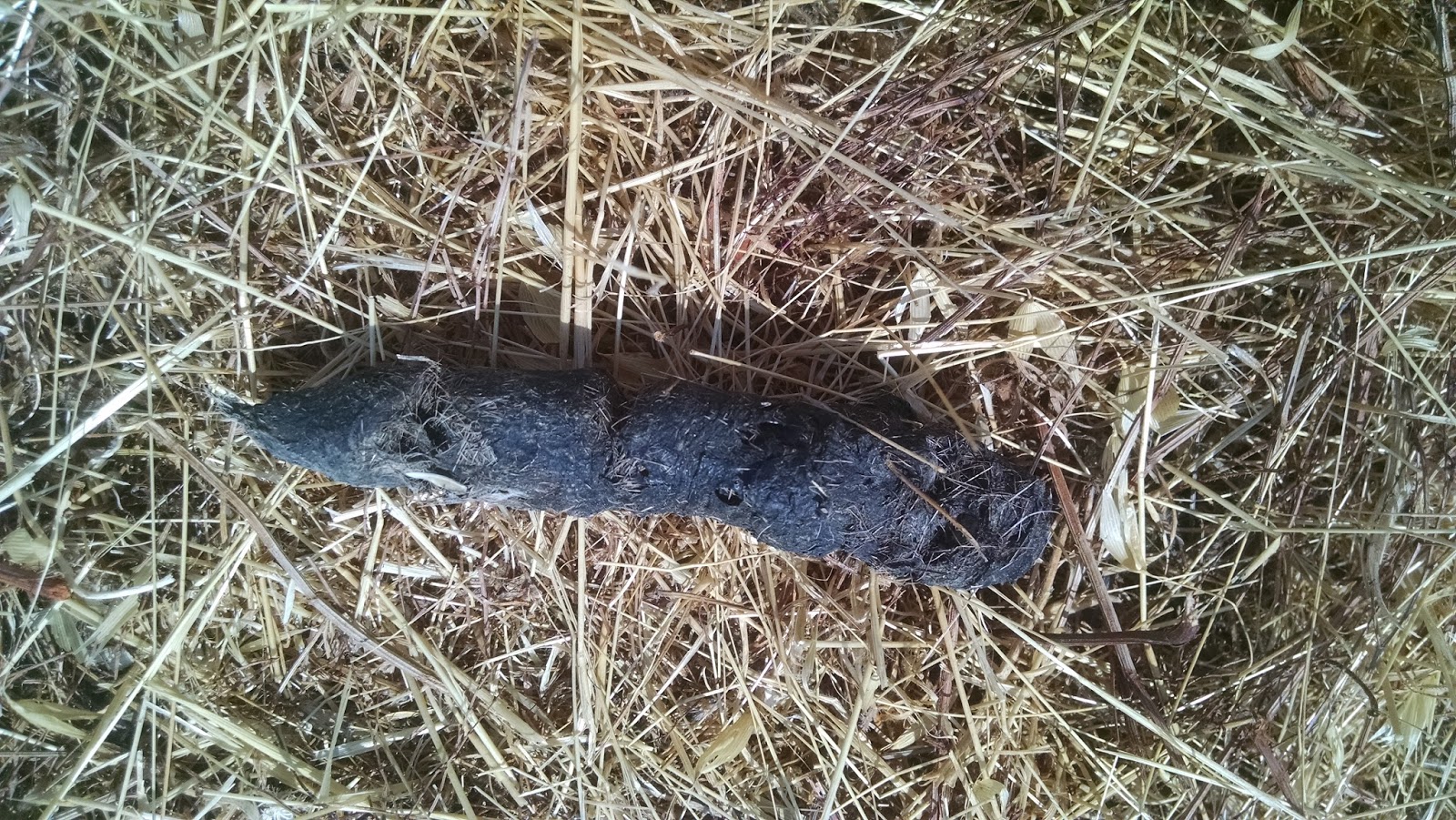
It is much easier when you keep passing very large scat, large and full of hair. These woods are full of lions. No need to slow down. No need to think about my lungs, or legs, or thirst. I just keep scanning the fog shrouded fields for eminent death.

This is not my normal Central Park run. This is Santa Cruz.
View from the Dorm. The city and ocean are below the fog.
I was out in the west for work. It was a conference complete with dorm room accommodations and a pass to the dining hall. Breakfast was served promptly at eight and more importantly, breakfast promptly stopped at nine. Not wanting to go hungry till lunch I set my alarm for Very Early. My schedule called for 19 miles. I mapped out a route. At dinner I swiped a bagel and snuck it past the zealous food police. Back in my room I reviewed the route, and once more, and turned out the light.

It turns out that the sun is different in Santa Cruz. It rises much later than in NYC. And yes, I had changed my clock the appropriate three hours. It was black outside the open window. The lucky kids in Santa Cruz don't need air-conditioning. They never have to try to sleep when the cool of the evening is in the upper 80s. Each night the temperature drops into the low 50s. As it turns out this means it was dark and cold outside the open window. And I had to get up and run.
Santa Cruz: end of the wharf, civil twilight.
I ate the stolen bagel, gulped as much water as I could, and headed out. I was on the road at five. There had been a couple of street lamps near the dorm. But on the road the university was rather stingy. Soon I was away from the buildings and under tall trees. I couldn't see the lines on the road. I couldn't see anything. I started to think about mountain lions.

When I arrived and was given the keys to the dorm I was also warned that losing them would cost me $140. In a moment of unrecognized genius I took off the miniature flashlight from my key chain and placed the two dorm keys on it. And there in the darkness I remembered it in a flash of inspiration. It took me a bit of time to fish it out of the tiny pocket in my shorts but I could again see the white line under my feet.

Astronomical twilight comes before nautical twilight and then civil twilight. From my experience astronomical twilight is a lot like pitch black darkness. Technically some of faintest celestial objects become harder to see as the night fades into astronomical twilight, but under the mountain lion trees there was no hint of brightness.

Still the flashlight wasn't needed for much longer. As I ran out from the trees I ran into the fog and the black turned into a dark, blinding, wet grey. The fog condensed on my beard and dripped into my lips. The wall of grey lit up into bright white as A car materialized in front of me. There was no sidewalk, barely any shoulder. I muttered repeatedly, "this is safe."

I ran down towards town past sleepy blocks and sleepier houses. I ran to the edge of town and out on the wharf. Between the gulls, seals, and the horn, it was a musical place. Back in the sunshine of yesterday I planned on taking my cell phone so that I could take a few pictures of the sunrise and the town. It was now just a few minutes before 6am. And while it was now civil twilight, and noticeably brighter, it was still dark and foggy. I snapped a couple of pictures and with the fear of missing breakfast in my tummy I ran on.
The lighthouse. The condensing fog makes for a soft focus.
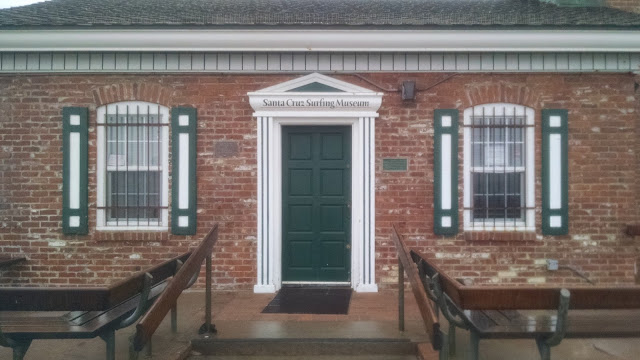
I ran along a beautiful road that curved along the coast up towards the lighthouse. The road was flat and smooth and as the sky brightened and the fog thinned the view improved. All of the houses were on the right and the cliffs down to the ocean were on the left. In a few miles I reached the lighthouse. Built on a jutting curve of land, the light house is short and squat and home to the Santa Cruz Surfing museum. More importantly it also has a water fountain. I refilled my bottle, enjoyed another energy goo and continued to run.
Unfortunately I didn't have time to stop in.
At the 8 mile mark I refilled my bottle for the last time. As I left the little beach front state park I ran out of town and up Highway 1. I started looking for the trail that would take me up the mountain and back towards the campus. I didn't need to look very hard. I should have known any mountain ascent would start at the very bottom. The path quickly gave up all of the elevation I had gained since the wharf and even tunneled under the highway right where I started to climb the mountain. And climb I did.

The entire mountain climb averaged to about a 10% grade. But plenty of little bits were much steeper. I was digging into the hill. I was almost all on the balls of my feet. In seconds my lungs were bursting. In seconds my pace had soared. Suddenly I was really thirsty and tired. And then I past by a pile of recently deposited cat scat.
Cat Scat found in Russian Ridge.

Usually keeping your mind off of the exhaustion is difficult on a long run. But the fear of being hunted, attacked, and eaten alive has a way of worming into one's mind. I tried to think about running and my tired legs, But all I could remember was that mountain lions are most active at dawn and dusk. I couldn't forget that it was dawn now and that I was running through thousands acres of state forests and fields. I couldn't shake the idea that I was moving and breathing like a overweight and severely injured deer. I couldn't shake the idea that I would miss breakfast while being breakfast.

I made my plan. I would keep my eyes very open. I would see the attacking cat. The plan failed to fully firm up past that first step. But it was a first step. I had some vague ideas of trying to look big, fighting back with the keys in my little pocket, and simultaneously soiling myself. That, save for the last bit, was the helpful advice the sign at the entrance gave: "If attacked, fight back!"

I scanned the fields of dry grass and fog for hungry cats. I kept my eyes peeled. And then I looked up and saw four large deer immediately in front of me. And in their bored glance my plan went out the window. A few paces later I stirred up a covey of quail. At least they seemed just as startled as me.

My water bottle quickly ran low. And the climbing mountain of fields and fog kept growing. There were more and more trail branches than I had seen on the map. I kept choosing up. At this point my fear of being eaten my tired legs were locked in a dead heat for my attention. Near the top of the mountain I saw my first sun beams. And Then I stumbled out of the fog and onto the top of the hill. I drank the last of the water and joined the road down towards the university.
Perspective. Red: Chicago Marathon, Blue: NYC, Purple: Portland, Green: Santa Cruz run.
To reach mile 19 I would need to run down to the road that led back up to the dorm. But my empty water bottle, my watch, and my legs all persuasively argued that I should cut it short. So when I saw a trail leading to what must have been the campus I took it. And since I'm writing this you know I was right. In fact, I made it back in time for breakfast. It was just as delicious dorm food ever was.

Tuesday, August 23, 2016

Following Phantoms

Another great day to donate! Two marathons and two charities! Let's raise a combined $6,500 for cancer research through Fred's Team and low-income seniors with Housing Opportunities and Maintenance for the Elderly (H.O.M.E.)!

Donate to H.O.M.E. here. Donate to Fred's Team here. More information here and at the top of the blog!

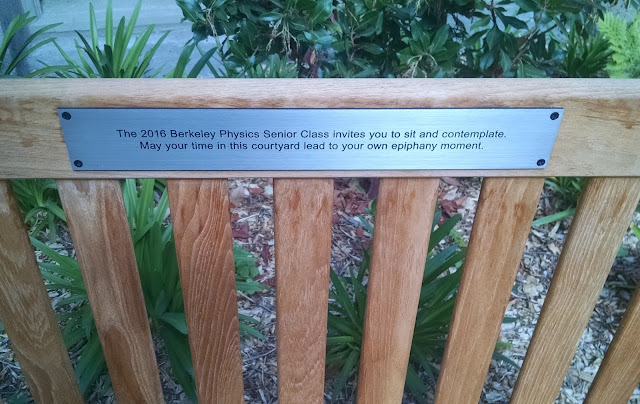
I looked up and felt ridiculous. My short pilgrimage had come to an end. In the plain courtyard I sat on the bench. I hadn't come for the bench, though I knew that was all that would be there. I sat for a moment longer. And then I left to wander back down through the green and bright of the waking world.

I knew there would only be a bench. Still I was hoping to find something else. I had come for him, or some tangible memory, or something. I hadn't planned this pilgrimage well.

It started when I left my car at the station and boarded the train into the city. I rolled slowly past miles of tightly placed homes, small and expensive. I switched to the metro and began counting down the stops as we popped above and below ground. It was 15. I had never been to Berkeley. It is beautiful. I didn't realize it was the first school of the University of California system. Calling themselves "Cal" makes more sense.

The physics seniors of the class of 2016 dedicated a bench to Charles Townes in the small courtyard next to his office. The old tree which had stood from beyond memory fell last year after he died. And in the passing of two such monuments they decided to redesign the little space into a courtyard to honor him.


He told the story of the creation of the maser in his books and in person. And always he recounted sitting on the park bench in Washington D.C. next to the blooming azaleas. It was there he received his revelation. And it was there that the entire world changed.

Sitting on this bench 2500 miles away I knew I had come too late. Though, there wasn't much I could do about that. The simple reality was that I was born far too late. Still I had come and instead of an epiphany I just felt silly. I had wanted to feel a connection, some recognition of his spirit, something. But why? I didn't know Dr. Townes in any real meaning of the word.

While I had met him once, it was when I was very young, and at a funeral. Still, he was a bit of family lore and his name and story stuck with me. But for years he was only lore. Then in college I wrote him. I don't know who found his address, or what I even wrote him. But I still have the letter and papers he sent in reply to mine. Even now they number among my dearest possessions. In them he shared his thoughts and encouraged me to be a scientist and a religionist. He wrote in bullets.


A few years later I invited him to come lecture at Yale and he did! I remember the beer he ordered at Mory's before his talk. I remember his lecture. I remember as much as I can. And I had the entire drive back to JFK with just him. He called the lab at 6 am local time, 3am at the lab (because he knew they would be working). He was always going. And he was 92 at the time. We parted at the terminal. He was off to California and then Qatar. And that was it.

Through the years I watched the news knowing some day it would come. And it finally did. I walked to the corner and bought the paper. It is still yellowing in my desk. The greatest experimental physicist of the 20th century. Perhaps that is more truly when this weird and slow and poorly planned pilgrimage began.

It ended in a little courtyard with a view of his old office and a few dumpsters. I didn't find him there. I didn't find a connection, any meaning, or even some special memory. I just found a bench. This family myth turned exemplar hero was yet again far ahead. I had come too late and he had gone to where I can not yet go, born too late as I am. So I went a bought a coffee.


In writing this post I remembered a video of Charles Townes reading poetry and thought I'd link it here. His bit starts at 20:20 (with a short introduction) I highly recommend starting there. Oh to be such a Renaissance man!

Monday, August 15, 2016

Running uphill

Another great day to donate! Two marathons and two charities! Let's raise a combined $6,500 for cancer research through Fred's Team and low-income seniors with Housing Opportunities and Maintenance for the Elderly (H.O.M.E.)!

Donate to H.O.M.E. here. Donate to Fred's Team here. More information here and at the top of the blog!

*full post to come, this is just a teaser.

Mile 11-16 are uphill, strongly uphill. Really strongly. Water bottle is low. No opportunity for a refill until 19 miles. Distracting oneself is key. If one doesn't, one stops. Distracting one's self from their leg tiredness, desire to stop, their bursting lungs is an art form. It isn't easy. It takes practice and effort. Usually.

It is much easier when you keep passing very large scat, large and full of hair. These woods are full of lions. No need to slow down. No need to think about my lungs. Just keep scanning the fog shrouded fields for eminent death.

Sunday, August 14, 2016

The Meeting

I'll bring you up to speed on my punishing run down and up the mountain soon. But for now see what we are enjoying - darkness at noon!

Oh power point. Hours and hours of power point.

Saturday, August 13, 2016

Santa Cruz

Another great day to donate! Two marathons and two charities! Let's raise a combined $6,500 for cancer research through Fred's Team and low-income seniors with Housing Opportunities and Maintenance for the Elderly (H.O.M.E.)!

Donate to H.O.M.E. here. Donate to Fred's Team here. More information here and at the top of the blog!

The flight went without incident. The sole grievance was that my seatmate passed enough gas for a return trip. Still it was smooth. Even the screaming infant slept until we started to descend. I caught In the Heart of the Sea and Hail Caesar. Neither were particularly good. I filled the remaining hour with episodes of Portlandia intermixed with staring at the flight information screen.

No one looks out windows any more. No windows are even open, presumably to maintain the viewing darkness. I would have enjoyed looking for mountains. So I satisfied myself with the rough map of the US and the little plane graphic that slowly updated our position. The windspeed, altitude and temperature were all reported. It is a rather odd thought (in the middle of a hot summer) to remember how thin the warm skin of air is. We were flying through ridiculous cold.

Our data last updated at we touched down. We were still supposedly 180+ feet above the service and cruising at a tortoise pace of 165 mph. And then the screen went blank.

A warm bus ride through traffic and mountains and now I am in my dorm room. I am hungry and there are still three hours till dinner. I walked to the cafe, but no one was there. It was open, but I couldn't find anyone to make me a sandwich. I may try the Mexican joint I heard about. I was told it was up "cardiac hill." Sounds promising.

All Back of the Bus

I'm headed to San Francisco and on to the Santa Cruz Developmental Biology Meeting.

Everyone seems more than a bit grumpy. The flight attendants are snappy, the passengers, after a ridiculous security line, an "issue with boarding," and an overbooked flight, are venomous, and the screaming infant in front of me seems to think she's being boiled alive in oil. Good morning!

Two years ago I made the same trip. I can't remember if there were any travel issues. All I remember is the great science, amazing weather, and Fantastic time playing in San Fran with M and J. I'm sure my memories of this trip will be the same.

But at the moment I'm all back of the bus, and not with the cool kids.